SIGGRAPH Asia 2026

LUMEN: Geometry-Guided Diffusion Model
for Spatially-Varying HDR Illumination Estimation

Hongze Chen1 Fangyu Lin1 Runze Zhang2 Lingting Zhu2 Keyang Luo2 Yingda Yin2 Zeyu Hu2 Weikai Chen2 Xin Wang2 Zehong Lin3 Jun Zhang1,*
1The Hong Kong University of Science and Technology 2LIGHTSPEED 3Lingnan University
*Corresponding author
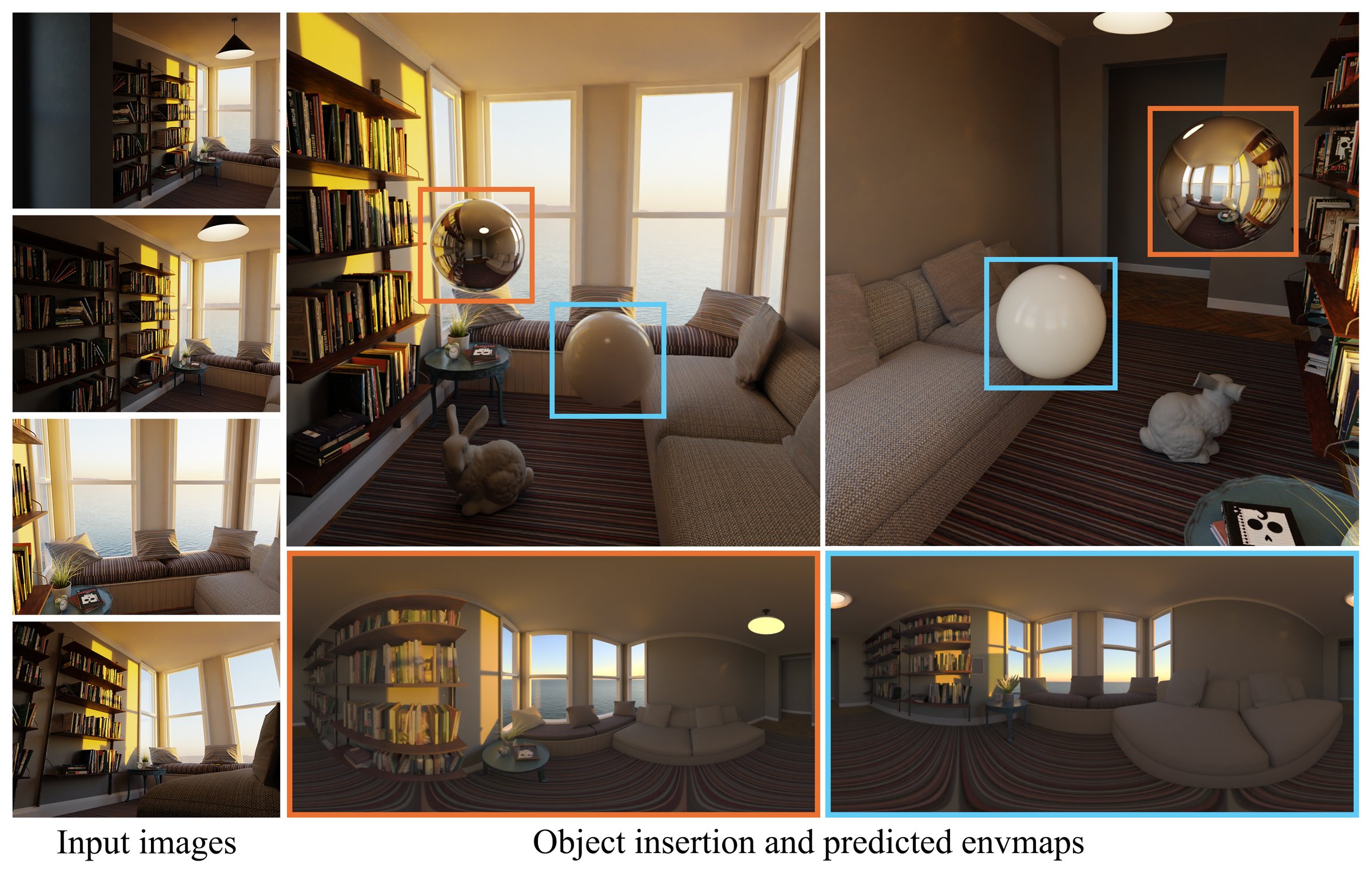
LUMEN teaser: multi-view input images, object insertion and predicted environment maps
Given a set of multi-view images, LUMEN estimates spatially-varying illumination at any location with consistency and achieves seamless virtual object insertion (the balls and the bunny are rendered using the predicted HDR environment maps at their positions).

Abstract

Estimating scene illumination from images is challenging as lighting is inherently spatially varying, depending on geometry, occlusion, and light sources. Existing methods incorporate geometric cues by deriving local environment maps or probe-based representations, but largely rely on regression or parametric models, resulting in over-smoothed lighting and limited realism. We revisit spatially-varying illumination estimation from a generative perspective and introduce LUMEN, a geometry-conditioned diffusion framework for synthesizing high-dynamic-range (HDR) environment maps at arbitrary spatial locations from single or multi-view images. Specifically, we reconstruct a coarse 3D scene from input images and render partial environment maps at arbitrary locations to encode visibility and spatial structure. These signals are fused with multi-view image features and fed into a diffusion transformer to generate full HDR environment maps. To train the model, we build a synthetic dataset of 700 indoor scenes with dense spatial supervision, including multi-view RGB images, depth, and HDR illumination at multiple sampled locations. This dataset enables the model to learn spatially consistent lighting distributions across diverse scenes. Extensive experiments demonstrate that LUMEN significantly improves visual fidelity and spatial coherence compared to prior approaches.
Method

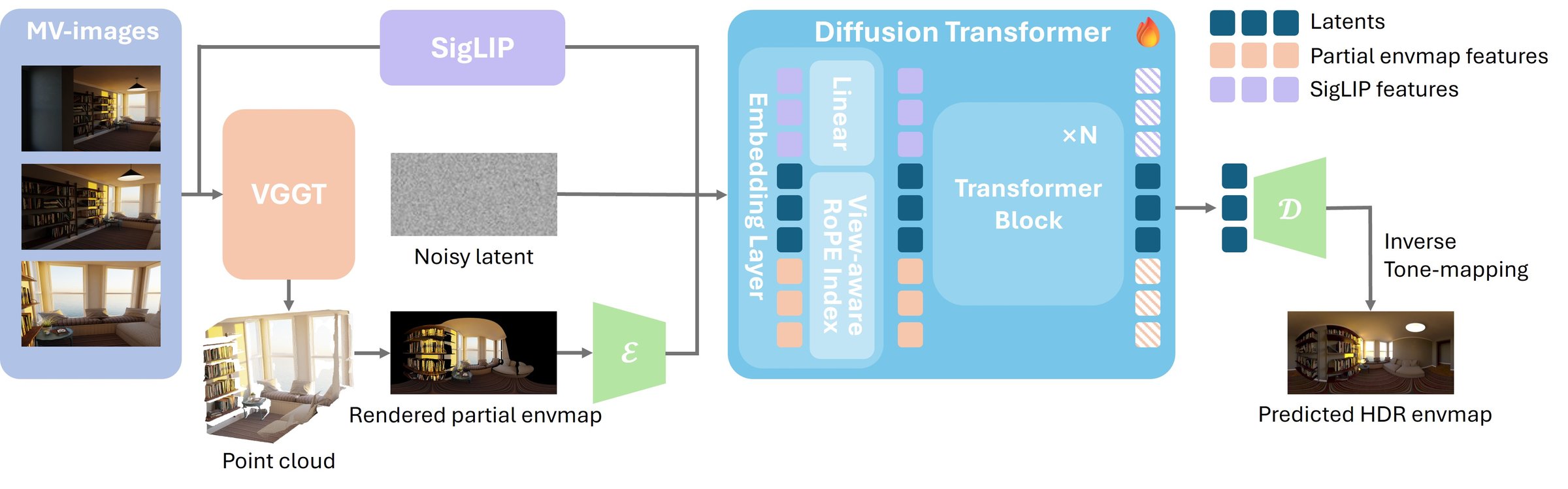
LUMEN pipeline overview
Overview of LUMEN. Given a single-view image or multi-view inputs, we first estimate the camera parameters and reconstruct a coarse point cloud using an off-the-shelf feed-forward 3D reconstruction model (VGGT). We then render partial environment maps at arbitrary locations in the scene based on the reconstructed geometry, and condition a 2D diffusion model on the input views with these partial environment maps to generate a complete HDR environment map.
01

Lighting as geometry-guided completion

For each query location, the reconstructed point cloud is rendered into a panorama centered at that location. This partial environment map captures visibility and occlusion, and serves as an explicit spatial condition: moving the query point changes the condition and thus the generated illumination.

02

Multi-view conditioned diffusion transformer

Built on FLUX.1-dev and fine-tuned with LoRA. Input views are encoded with SigLIP, the partial environment map with the VAE; both are concatenated with the noisy latent into a unified token sequence with a view-aware RoPE index. HDR is recovered by inverse Reinhard tone mapping.

03

Dense spatially-varying supervision

A synthetic dataset of ~700 indoor scenes built on Infinigen Indoors, with multi-view RGB images, depth, cameras and HDR light probes at many locations, combined with 1,527 real-world HDR panoramas for robustness in the wild.

Spatially-Varying Lighting Estimation

Real-world demo

A virtual light probe is placed directly in front of the camera. As the camera moves through the real scene, LUMEN predicts the HDR environment map at the probe's current location, and the probe is rendered with it, so its reflection follows the changes of the surrounding illumination.
In-the-wild scenes

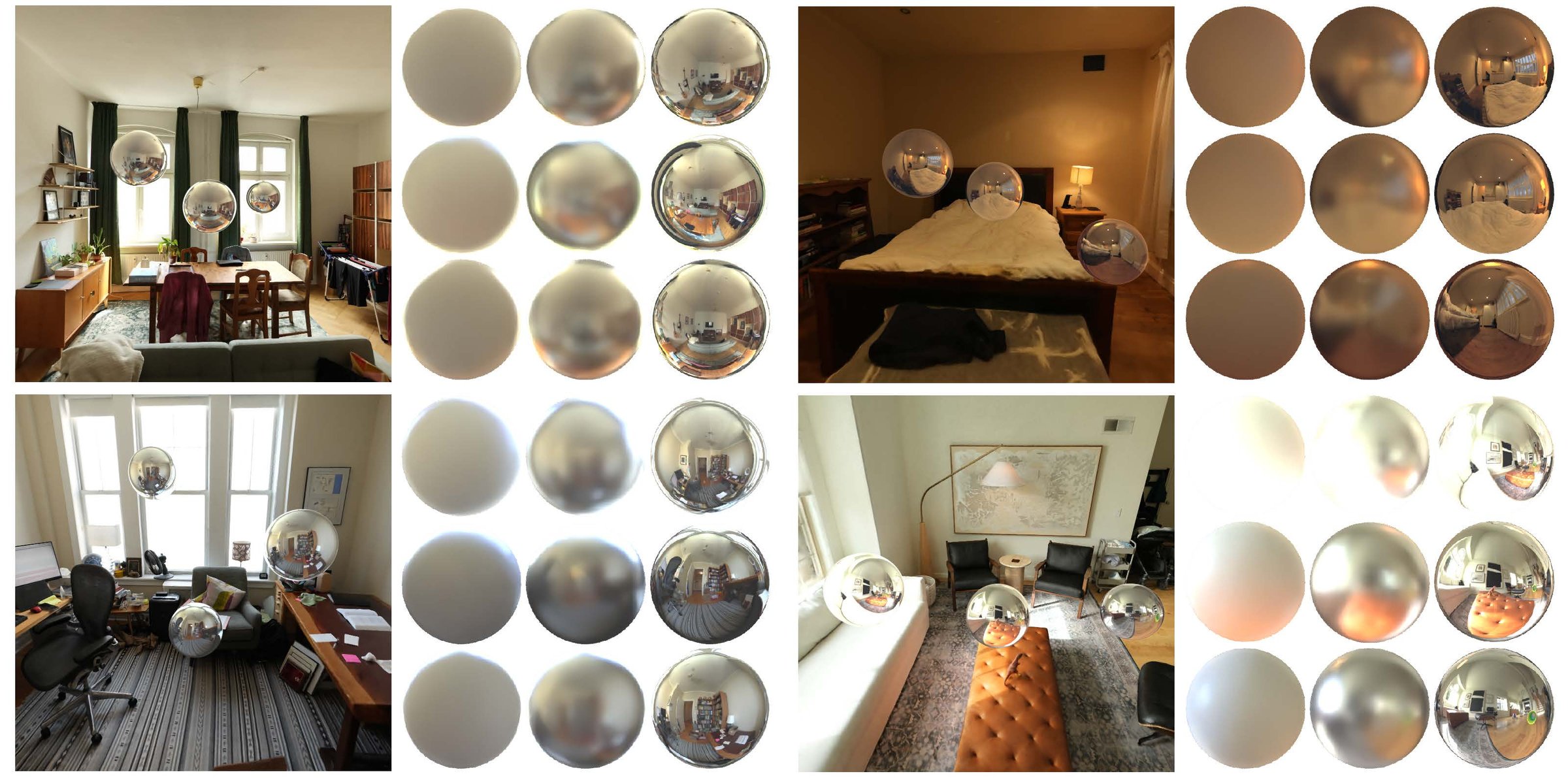
Spatially-varying illumination on in-the-wild scenes
Visualization of the estimated spatially-varying illumination on in-the-wild scenes. The inserted spheres in each photo correspond one-to-one to the renderings on its right: spheres ordered from left to right match the rows from top to bottom (diffuse, matte silver and mirror materials).

Comparison from a single-view image

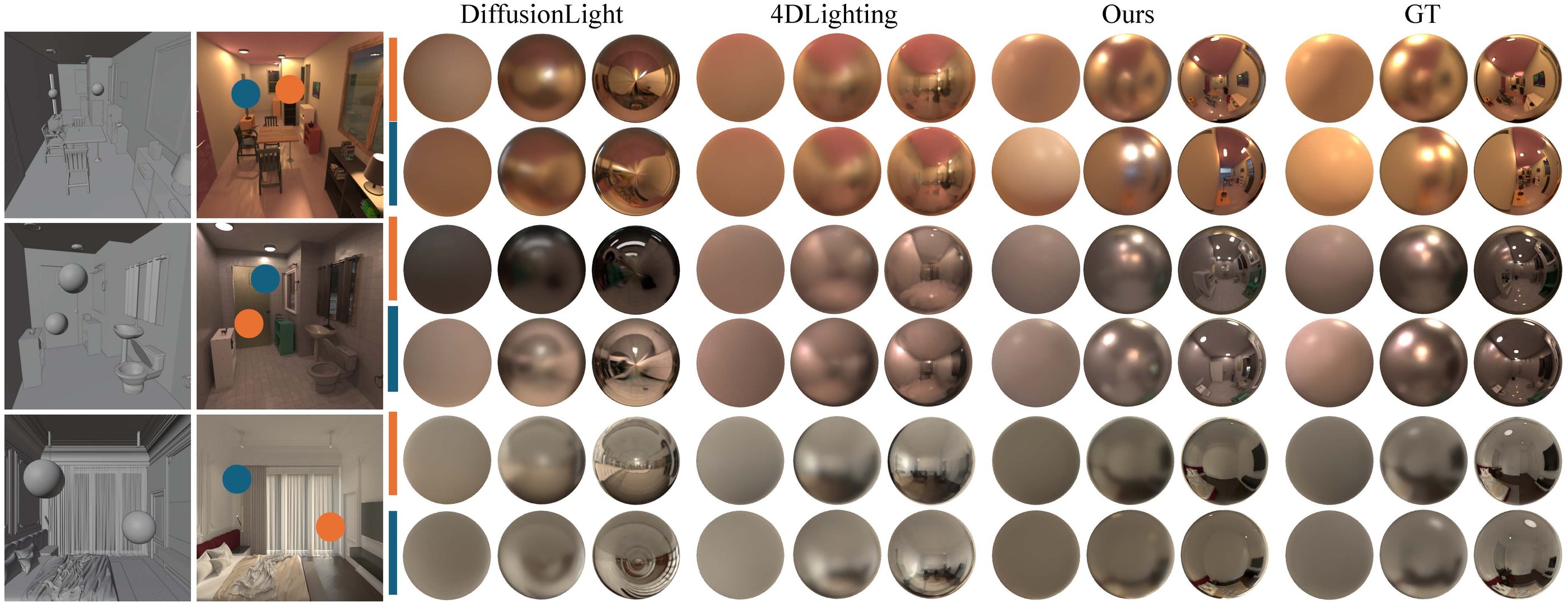
Qualitative comparison of spatially-varying lighting estimation from a single-view image
Qualitative comparison of spatially-varying lighting estimation from a single-view image. Each pair of rows corresponds to the two probe locations marked in the input image. LUMEN localizes light sources accurately and produces illumination that changes coherently with the probe location.
Quantitative comparison for spatially-varying lighting estimation
Lower is better for RMSE, si-RMSE and angular error; higher is better for SSIM. Best results per setting in bold.

HDR Environment Map from a Single Image

Comparison on Laval Indoor and Laval Outdoor

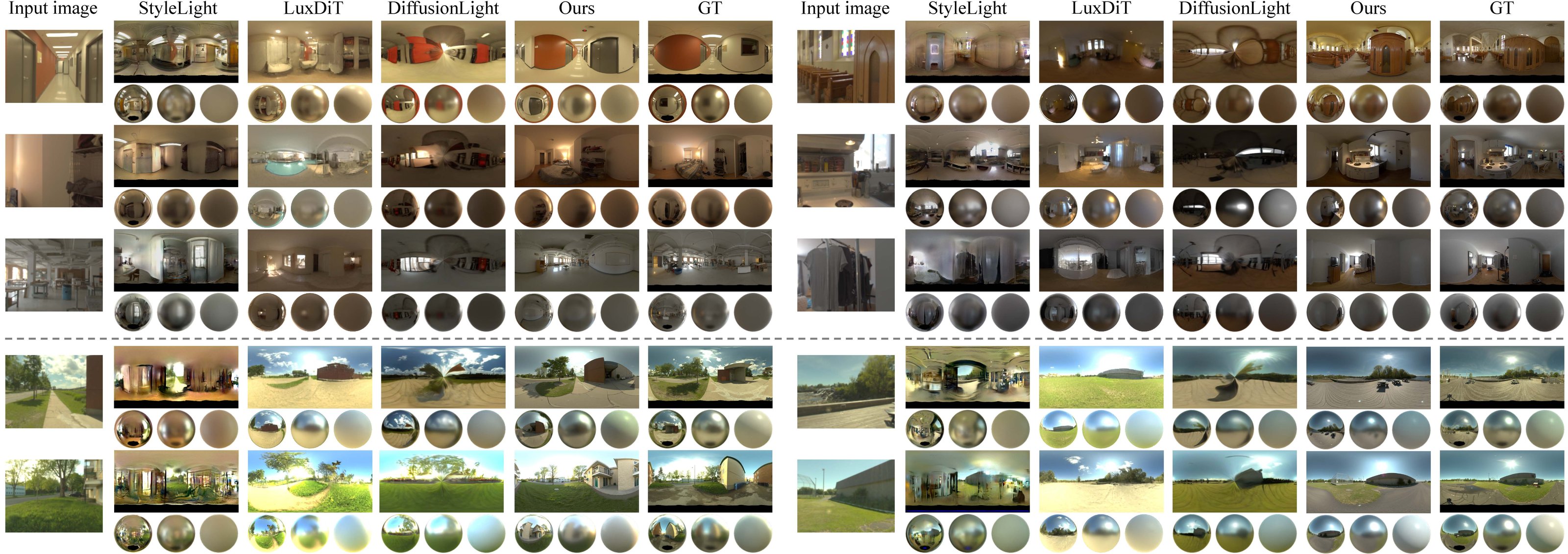
Qualitative comparison on Laval Indoor and Laval Outdoor
Qualitative comparison on the Laval Indoor (left) and Laval Outdoor (right) datasets. LUMEN yields higher visual fidelity and more accurate localization of light sources. Click to zoom in.
Quantitative results on Laval Indoor and Laval Outdoor
Lower is better. Best results per dataset in bold.

In-the-wild HDR panorama generation

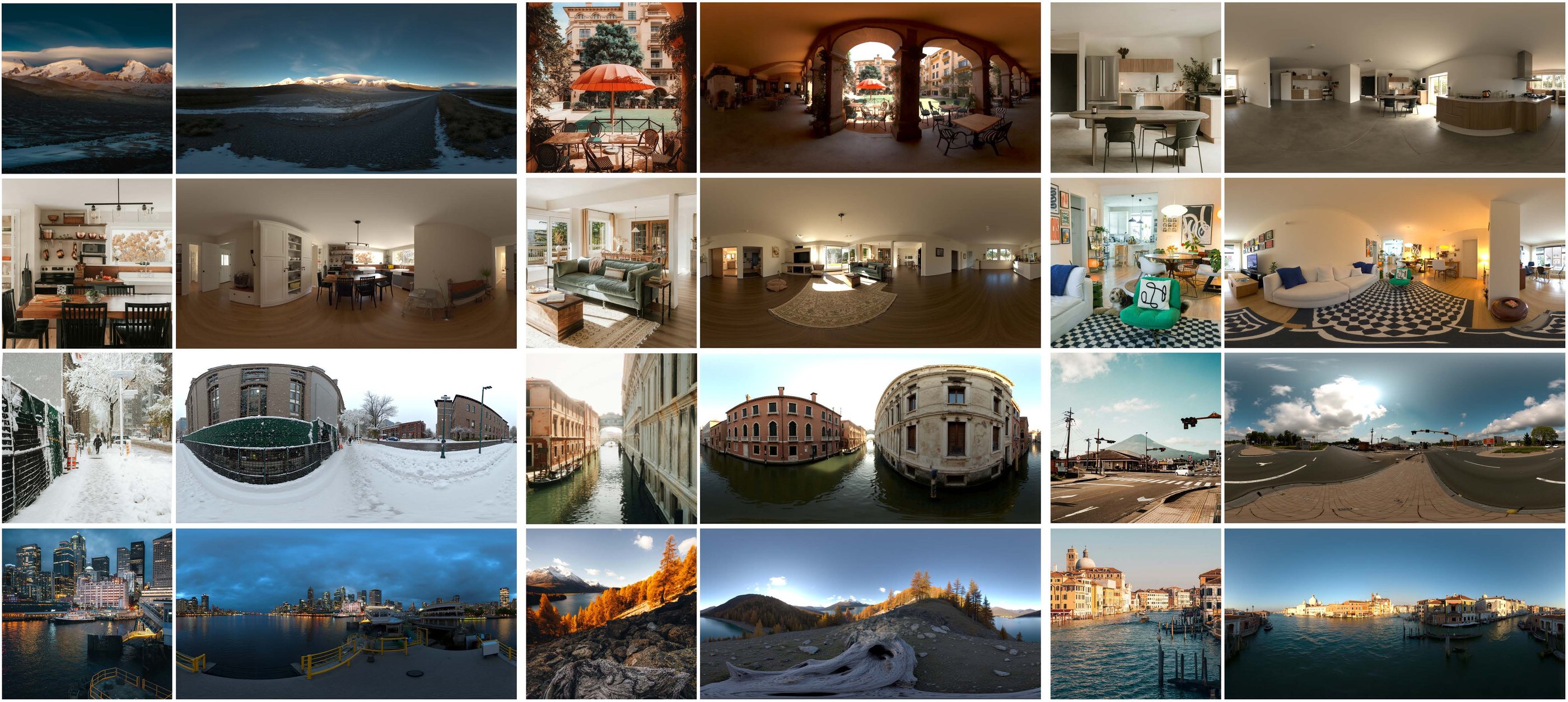
HDR panorama generation from in-the-wild images
Image-conditioned HDR panorama generation on real-world captures. Each pair shows the input photo (left) and the generated 360° environment map (right), covering indoor and outdoor scenes.

Virtual Object Insertion

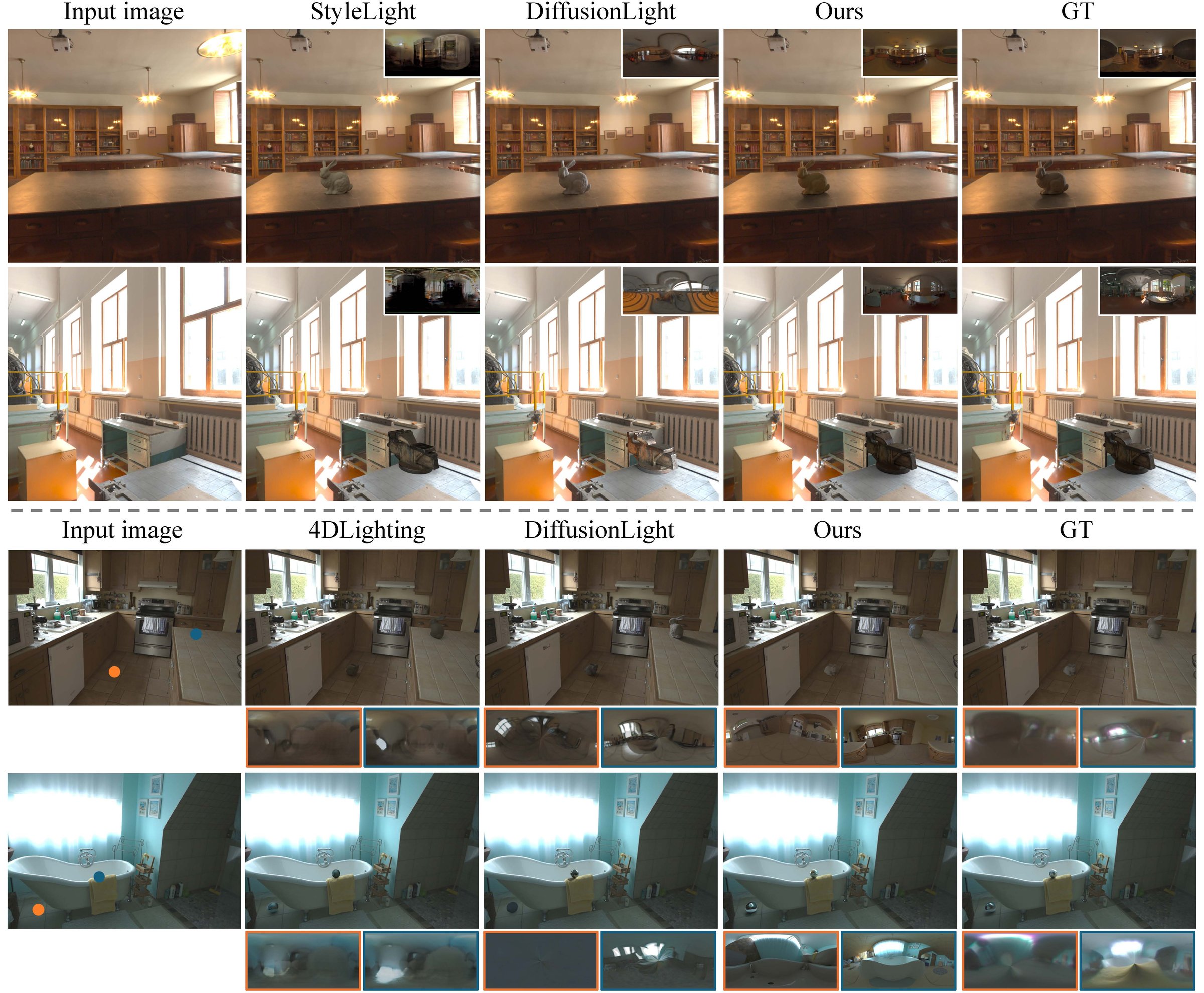
Object insertion comparison
Qualitative comparison of object insertion on the Laval Indoor dataset (top) and the Laval Indoor Spatially Varying HDR dataset (bottom). Objects rendered with LUMEN's environment maps show more accurate color, brightness and shadows. Click to zoom in.
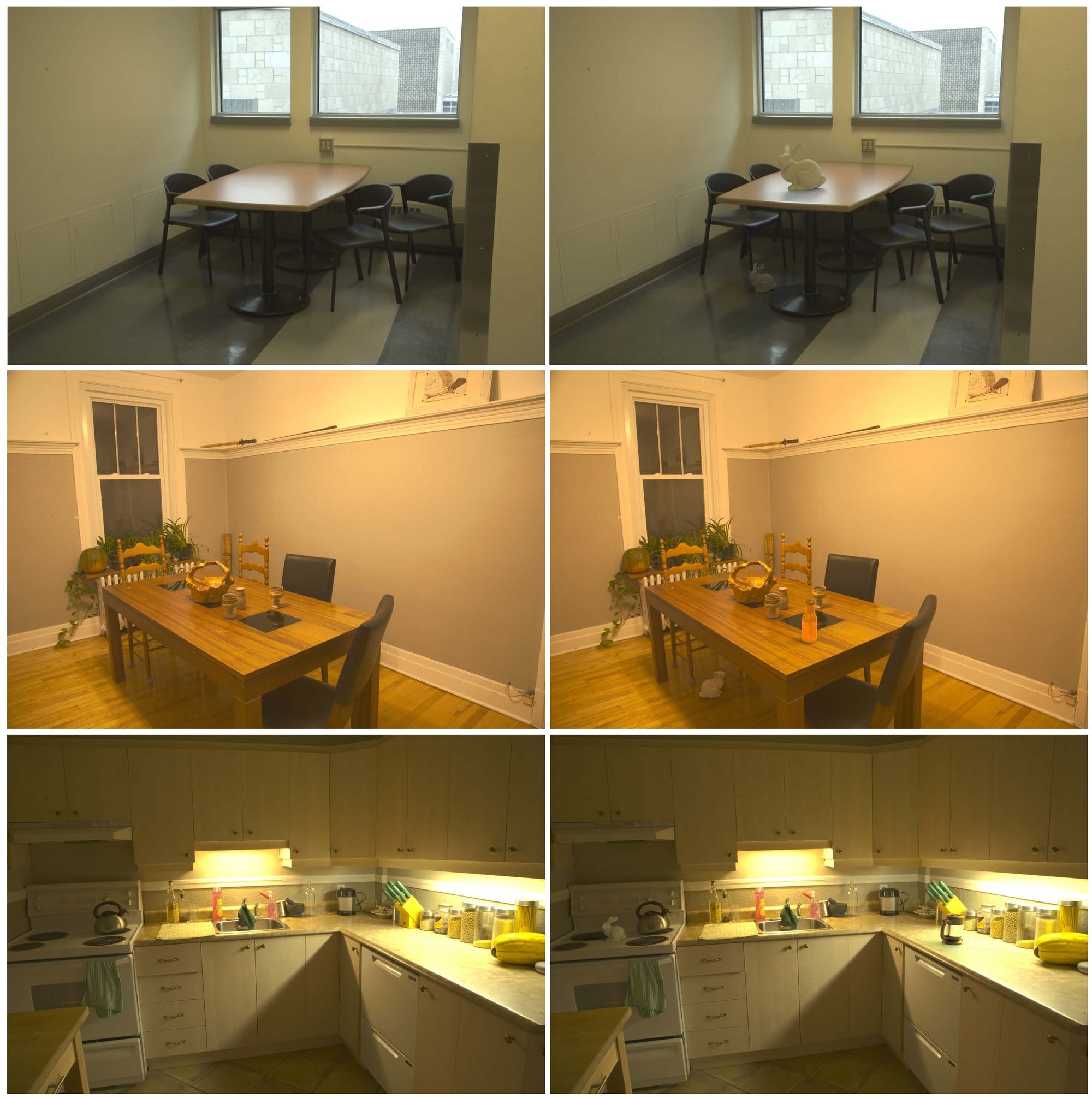
Object insertion on the Laval Indoor Spatially Varying dataset
Object insertion results on the Laval Indoor Spatially Varying dataset: original photo (left) and virtual objects rendered with the spatially-varying illumination predicted by LUMEN at their locations (right).

BibTeX

@inproceedings{lumen2026,
  title     = {LUMEN: Geometry-Guided Diffusion Model for Spatially-Varying HDR Illumination Estimation},
  author    = {Hongze Chen and Fangyu Lin and Runze Zhang and Lingting Zhu and Weikai Chen and Zeyu Hu and Yingda Yin and Keyang Luo and Xin Wang and Zehong Lin and Jun Zhang},
  booktitle = {ACM SIGGRAPH Asia 2026 Conference Papers},
  year      = {2026}
}